Summary: Businesses are moving away from isolated camera systems toward cloud-based security camera systems for businesses that support real-time visibility, faster response, and centralized control. The article describes cloud video surveillance operations and demonstrates how remote monitoring and alerts enhance safety, explains the importance of cloud-based CCTV recording for business operations, and shows how data protection procedures work. The research investigates emerging trends in cloud-based video surveillance, which assess operational results instead of security claims.
Businesses today face evolving threats from theft, operational gaps, and compliance demands. The worldwide video surveillance market reached a valuation of about USD 74 billion in 2024 and is projected to surpass USD 147 billion by 2030 because commercial, industrial, and institutional facilities around the world are adopting the technology.
This growth depends heavily on cloud platforms, which serve as its foundational technology. These platforms enable organizations to expand their video security capabilities without major infrastructure investments, providing continuous security monitoring across multiple locations of varying sizes and operational capacities. The combination of these elements enables businesses to monitor their operations efficiently throughout different types of facilities, which require continuous security surveillance and immediate operational responses.
What Are Cloud-Based Security Camera Systems for Business?
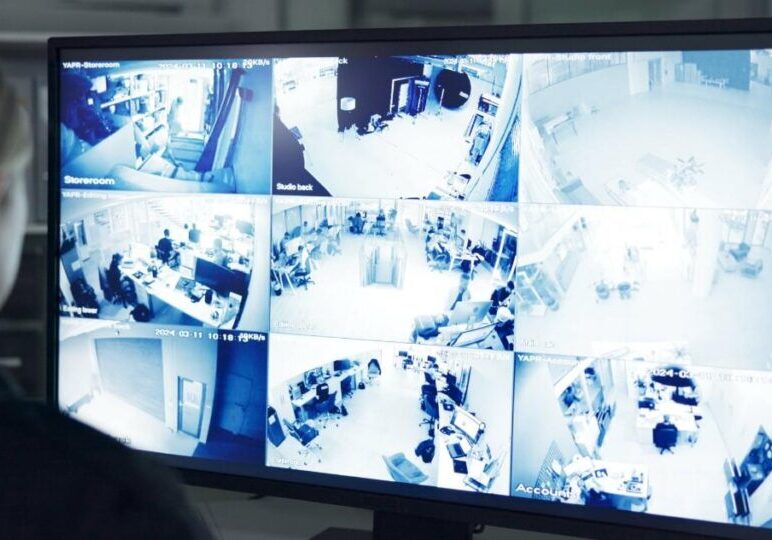
Cloud-based security camera systems handle video storage, management, and analytics functions through their secure data centers. The cameras continue to function at their physical site while their recorded footage gets sent to cloud servers through the network instead of being kept on local storage devices.
The system enables organizations to handle all their operations, including camera management, user access control, alert monitoring, and storage functions from one central system, which works across multiple sites.
How Cloud Video Surveillance Works

At a basic level, cloud video surveillance follows a clear process:
- Cameras capture video at the site
- Footage is encrypted and transmitted over the network
- Video is stored securely in the cloud
- The authorized users can access both live and recorded footage through web and mobile interfaces.
The system enables centralized management to apply system updates and permissions, and configuration changes without requiring technicians to visit the site.
Why Are Businesses Moving Away From Traditional CCTV?
Legacy CCTV systems rely on their local recorders, which have limited sharing capabilities. The very name “Closed-Circuit Television” reflects the inherently local operation of the camera and storage system. While these systems continue to record video, their operational limitations create safety risks and reduce overall efficiency.
Common challenges include:
- Footage lost due to damaged or stolen recorders
- Limited or no remote access
- Time-consuming searches through local storage
- Difficulty scaling across multiple locations
Cloud platforms solve these problems by providing video access through their cloud system, which operates independently of physical infrastructure while allowing operators to monitor all activities from a single location.
How Do Remote Monitoring and Alerts Improve Safety?
The way businesses manage incidents has changed due to AI alerts and remote monitoring technology. Teams can now respond to incidents in real time, rather than waiting for problems to occur. Current systems use rules-based and AI-assisted approaches to generate alerts that detect motion, intrusion, loitering, and unauthorized access to restricted areas. These systems create active alerts that follow established response procedures, rather than functioning as simple notifications.
Who Receives Alerts and What Happens Next?
Alerts can be directed to:
- An onsite security or operations team
- A third-party live video monitoring center
- Designated local or regional managers or compliance staff
Response protocols are established through a predetermined definition. The available actions for the event response include live video examination, audio warning issuance, and onsite staff communication and law enforcement escalation when necessary.
This approach reduces response time and ensures that video data leads to action, not just documentation.
Considerations for Cloud Video Surveillance
While cloud video surveillance offers significant operational benefits, there are a few factors to consider:
- Bandwidth Requirements: Cloud systems rely on internet connectivity, so sufficient ISP bandwidth is needed to support high-quality video streaming from multiple locations.
- Cost Factors: Depending on scale and retention needs, the total cost of ownership may be comparable to or slightly higher than that of on-premises solutions.
- Data Security: Cloud storage requires careful management of access controls and vendor security practices. A breach could potentially impact multiple sites, so security protocols are critical.
These factors are not exclusive to cloud solutions. Many also affect on-premise systems, though the implications may vary.
What Are the Practical Benefits of Video Surveillance in the Cloud?
Cloud video surveillance supports daily operations because it offers more than just protection against theft. Businesses benefit from both cloud-based and on-premise solutions, but find cloud platforms to deliver better flexibility and operational efficiency.
Faster Incident Review
Footage is divided into sections by time, event, and camera. This makes it easier to locate specific clips, saving hours during both review and investigation processes.
Improved Accountability
Controlled user permissions help establish accountability for team members while protecting confidential footage.
Reduced Infrastructure Burden
Cloud systems eliminate the need for on-site server management, reducing maintenance requirements, operational downtime, and energy and equipment costs.
Why Does Cloud-Based CCTV Recording Matter?
The cloud video recording system secures businesses against the risk of losing their entire operations through a single system failure. Local recording devices face multiple risks, which include theft, fire, flooding, and hardware breakdowns. Cloud-based storage enables continuous access to footage even when physical locations experience security breaches.
Cloud-based CCTV recording enables organizations to implement retention policies that meet their operational requirements and regulatory obligations. Organizations can keep their video recordings for specific time frames while their storage space operates without any active procedures to track capacity usage.
How Is Data Protection and Security Handled?
Security is a primary concern when video leaves the physical site. Cloud platforms address this through layered controls.
Common Security Measures Include:
- Encryption for video in transit and at rest
- Role-based access controls
- Multi-factor authentication
- Redundant storage across multiple data centers
These controls help protect sensitive footage and support privacy requirements without relying solely on local safeguards.
How Does Cloud Video Fit Into a Unified Network and Security Platform?
Cloud video works best when treated as part of a unified infrastructure. Cameras, access control systems, IoT sensors, and guest networks all rely on the same underlying network.
A unified platform allows businesses to:
- Monitor physical and digital activity together
- Reduce blind spots between systems
- Manage security and operations from one environment
This approach improves efficiency and supports future expansion without redesigning the entire system.
What Role Do Virtual and Remote Security Patrols Play?
Cloud systems enable virtual security patrols without constant onsite staffing. Trained operators can review live camera views at scheduled or random intervals.
Common Use Cases Include:
- Checking rear entrances and loading docks
- Verifying cleanliness and safety conditions
- Monitoring trash areas or storage zones
- Confirming restaurant prep and service areas
These patrols cover the same visual checks a physical guard would perform, while reducing staffing costs and extending coverage.
How Are Remote and Low-Traffic Areas Monitored?
The parking spaces in the back and the areas used for utilities and the storage facilities do not receive proper maintenance because their operational hazards exceed standard safety levels. The cloud-based surveillance systems enable monitoring of these areas without the need for security personnel to be present at all times.
The AI-assisted alerts system detects unusual movement patterns, which teams use for their real-time event monitoring activities. The method becomes more effective because it combines remote monitoring with existing operations, which helps to reduce hidden areas of the system and enhance emergency response capabilities during times when most incidents occur undetected.
What Are the Future Trends in Cloud-Based Video Surveillance?
Cloud-based video surveillance is evolving into a core operational system rather than a passive security tool.
Smarter AI Detection
The increasing accuracy of advanced analytics systems decreases false alarm rates while they accurately detect actual security threats. The system enables teams to concentrate their efforts on investigating significant incidents that matter most to their work.
Stronger Integration Across Systems
Video platforms are increasingly connected with access control, alarms, and IoT devices. This creates a unified view of security and operations across the entire facility.
Automated Incident Response
Modern systems have the ability to start designated procedures that security teams established before an event occurs when they receive a security alert through access point shutdowns and the transfer of incidents to response teams.
These developments help organizations react faster, improve situational awareness, and reduce the need for constant manual monitoring while maintaining tighter control over their environments.
Conclusion: Cloud Video as an Operational Asset
Resolute Partners offers Live Video Monitoring, which serves as more than a basic system that records events that happen after their occurrence. The system delivers ongoing property surveillance, which enables immediate response actions and creates recorded documentation of all emergencies. Resolute uses its monitoring expert team and established response procedures and unified video system to help organizations decrease security threats during non-working hours and complete security assessments while their current security staff remains on duty.
Live video monitoring is not about more cameras. It is about smarter coverage, faster response, and consistent protection when your property is most vulnerable.
If your organization needs more than unmonitored cameras, Resolute Partners can help. Our Live Video Monitoring services create system integrations unified with existing systems while enabling single facility and multiple facility operations.
Contact a Resolute expert to review your security requirements and design a monitoring solution that delivers real-time data protection and security, clear response paths, and operational confidence.
Frequently Asked Questions
Q1. How Do Cloud Security Camera Systems Work?
Cloud security camera systems operate through video transmission, which sends encrypted footage from cameras to distant servers for storage and system management. The system allows authorized users to view both live and recorded videos through protected platforms, which do not require them to use local recording devices.
Q2. Are Cloud Video Systems Suitable for Large Enterprises?
The cloud system enables government and enterprise organizations to manage their operations from various sites while maintaining central control.
Q3. What Happens If Internet Connectivity Is Lost?
The majority of systems enable users to store data locally, which allows them to continue working until they regain internet access. Hybrid architectures serve as the operational framework for critical environments.
Q4. How Secure Is Cloud-Hosted Video Footage?
Cloud platforms protect videos through encryption and access control mechanisms while maintaining system redundancy to ensure content accessibility.
Q5. Can Cloud Video Integrate With Other Security Systems?
Cloud video systems establish connections with access control systems, alarms, and IoT sensors through a unified networking and cybersecurity platform.

Michael S. Blanco is the Chief Executive Officer and Co-Founder of Resolute Partners, LLC, where he leads strategic initiatives across various divisions. After owning family entertainment centers in New England, he co-founded Resolute Partners in 1996, launching the first Internet cafés for the U.S. Navy and partnering with AT&T for global deployment. A pioneer in wireless communications, Michael has expanded the company’s focus to include Energy Management/IoT, Cybersecurity, and Managed Video Security. He holds a degree from the Rochester Institute of Technology.

Stay up to date.
Subscribe for latest news, protection tips, special offers, and more!


Live Video Monitoring
Our trained video security surveillance monitoring professionals can quickly spot suspicious activity captured by business security cameras. We review live video to determine if criminal behavior is suspected.